
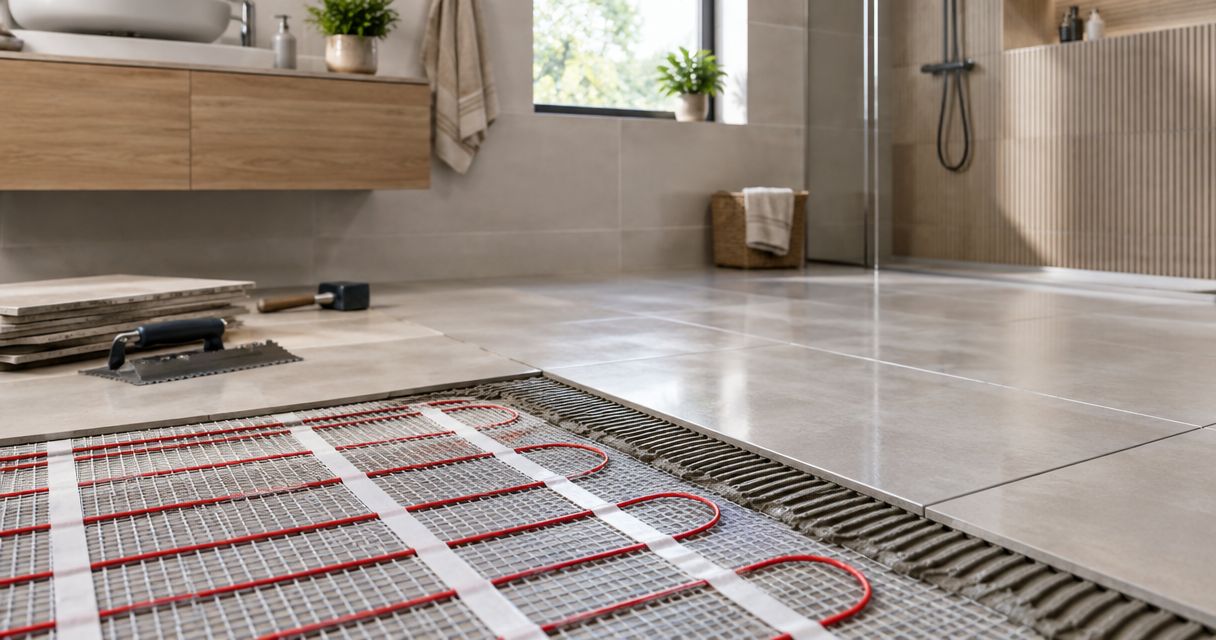
Heating mat under tiles for homeowners in Poland is a thin electric heating element installed beneath tile or stone flooring to warm the surface directly, with the goal of eliminating cold floors in bathrooms, kitchens and hallways without ripping out a radiator system. Homeowners care about different things than commercial installers: quiet operation, low running cost on standby, a system that survives a bathroom renovation, and installation that doesn't require lifting the whole subfloor.
- A mata grzewcza pod płytki (heating mat under tiles) warms tile floors directly and works under any hard flooring in a bathroom or kitchen.
- Cyclocarbon infrared film from BARS-IR heats evenly across the surface instead of in stripes, which matters most under large-format tile.
- Typical film-based mats run 100-160 W/m² — check the spec sheet for the exact mat before ordering.
- Budget cable mats cost less upfront but concentrate heat in lines and take longer to warm a room.
- Test the mat before you tile — a dead heating element under grout is a full floor tear-out to fix.
Why heating mat under tiles matters for homeowners
Tile is one of the coldest flooring materials in a home because it conducts heat away from bare feet fast — that's true whether the room sits above a heated basement or a cold crawlspace. In 2026, most heating mat installs in Polish homes still happen during a bathroom or kitchen renovation, not new construction, which changes the constraints: you're working around an existing subfloor, an existing drain, and a budget that already went to tile and fixtures.
Homeowners also live with the system daily, so noise, uneven warm spots, and slow warm-up times are dealbreakers in a way they aren't for a rental unit or a builder doing volume installs. A mata grzewcza pod płytki that heats unevenly shows up as cold feet on one side of the shower and a warm patch by the vanity — a complaint that never happens with a full-surface infrared film.
Measure your floor area first
Get the exact heated area before you look at a single product — this decides mat size, power draw, and whether you need one thermostat zone or two.
- Measure the room in square metres, then subtract the footprint of the toilet, tub, and any built-in cabinetry.
- Leave a 5-10 cm gap around the room perimeter and under fixed fixtures — mats shouldn't run under the toilet base or cabinet feet.
- Note the door swing and any threshold transitions where the heating layer needs to stop.
- Sketch where the thermostat sensor probe will sit, ideally away from direct sun or a floor vent.
- Confirm the finished floor height increase is acceptable against existing door clearances.
Choose the right heating technology
Most homeowners default to whatever the tile installer stocks, which is usually the cheapest cable mat. That's a mistake if even heat and low profile matter more than upfront cost.
- Resistance cable mats — a single wire looped in a fixed pattern, cheapest option, heats in stripes rather than evenly.
- Woven mesh electric mats — cable pre-spaced on a mesh backing, faster to install than loose cable, still heats in lines.
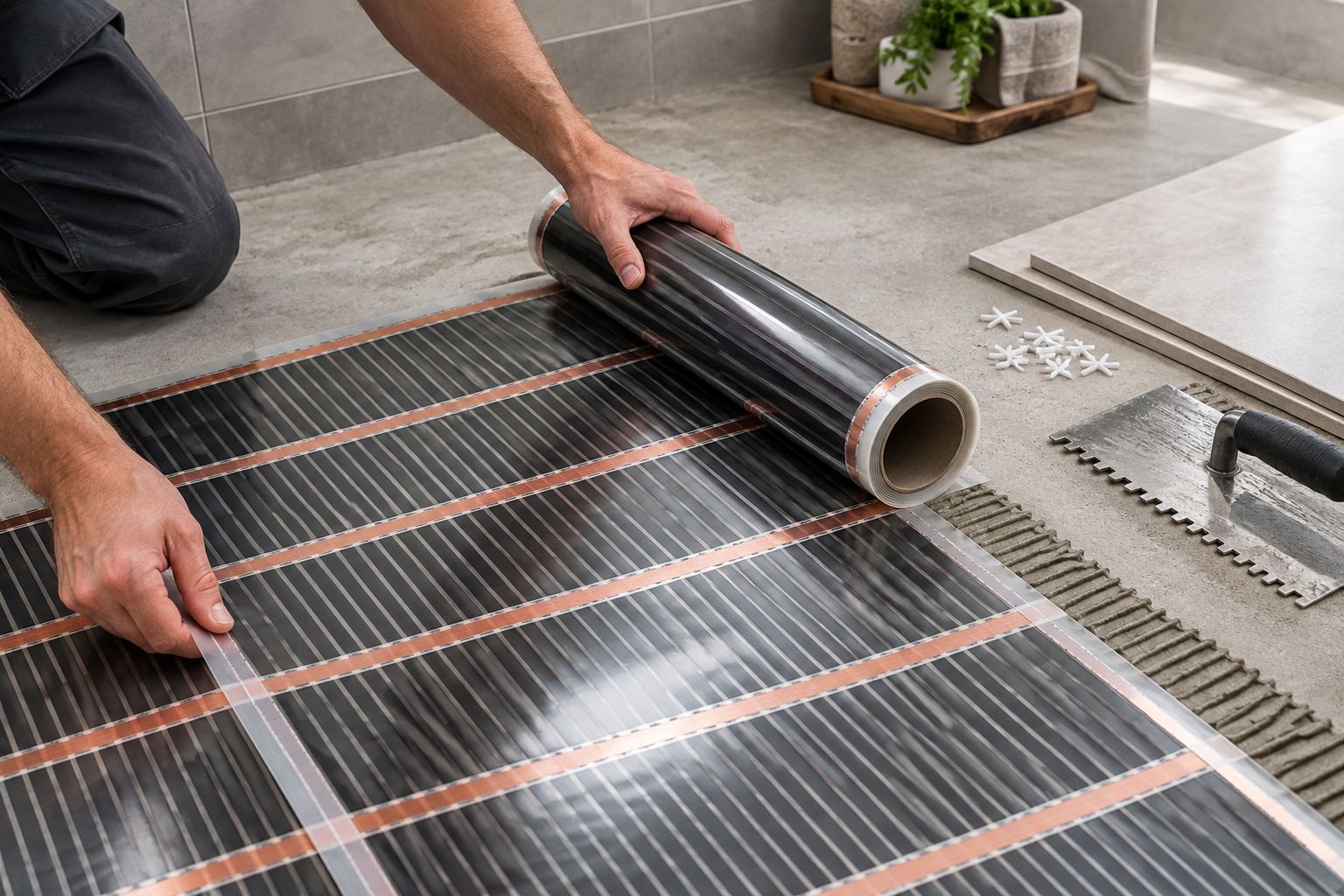
- Infrared film mats (like BARS-IR's cyclocarbon film) — a flat conductive layer that heats the full surface, thinner profile, better for large-format tile.
- Hydronic (water) loops — tied into a boiler or heat pump, best for whole-home retrofits, not a bathroom-only fix.
The manual path here is a cable mat from a hardware store, laid and set by the tiler as part of the job. The faster path, once you know your square metres, is ordering a cyclocarbon infrared film sized to the room from BARS-IR and letting the installer lay it as one continuous layer instead of routing cable by hand.
Check your subfloor and insulation
A heating mat wastes energy fighting a cold subfloor before it warms your feet, so this step isn't optional in an older Polish home with an unheated space below.
- Confirm the subfloor is flat, dry, and free of old adhesive ridges before the mat goes down.
- Add an insulation board under the mat if the room sits over an unheated basement or garage.
- Check for existing floor sensors or old heating cable from a previous install — remove or map around it.
- Verify the subfloor material is rated for the tile adhesive and heating layer combination.
Plan the thermostat and controls
The thermostat decides whether the system feels responsive or sluggish, and it's the one component homeowners regret cheaping out on.
- Pick a thermostat with a floor sensor, not just an air sensor — floor temperature is what protects the tile adhesive.
- Set a programmable schedule so the floor is warm at 6:30 AM, not running at full power all night.
- Check that the thermostat rating matches the mat's total wattage with headroom, not right at the limit.
- Confirm the thermostat mounts at a height and location that's actually reachable, not buried behind a door.
Install the mat under the tile
This is the step where DIY confidence causes the most expensive mistakes — a torn heating element gets discovered only after the grout goes down.
- Dry-fit the mat on the floor before applying any adhesive, checking coverage against your measurements.
- Keep the mat at least 5 cm from the toilet flange, drain, and any built-in fixture base.
- Use a self-leveling or thin-set compound rated for use over heating elements, not standard tile adhesive alone.
- Route the sensor cable and power lead to the thermostat location without kinking or crossing over the heating element.
Test before you tile
A continuity and resistance test takes minutes and catches a damaged element before it's sealed under $500 of tile.
- Test the mat's resistance with a multimeter and record the reading against the manufacturer spec.
- Take a photo of the mat layout before covering it — useful if anyone ever needs to drill into that floor.
- Run the system briefly on a low setting before final tiling to confirm even warm-up across the surface.
- Re-test resistance again after tile adhesive cures, before grouting.
Get a mat sized to your room
Send your floor measurements and get a cyclocarbon film recommendation.
Comparison: heating options for homeowners in 2026
| Option | Best for | Key limitation |
|---|---|---|
| Resistance cable mat | Tightest budgets, small bathrooms | Heats in stripes, slower even warm-up |
| Woven mesh cable | Faster install over cable alone | Still line-based heat, thicker profile |
| Cyclocarbon infrared film | Large-format tile, even full-surface heat | Requires accurate room measurement before ordering |
| Hydronic loop | Whole-floor or whole-home retrofit | Needs a boiler or heat pump tie-in, bigger job |
Verdict: for a single bathroom or kitchen retrofit in 2026, a cyclocarbon infrared film mat wins on even heat and low profile — a resistance cable mat is the budget fallback for a room under 4 m².
Common mistakes homeowners make
- Skipping the resistance test before tiling — the single most expensive mistake, since fixing a dead element means removing finished tile.
- Sizing the mat to the whole room instead of the walkable area — wastes power heating space under the tub and vanity that never gets stepped on.
- Choosing an air-sensor-only thermostat — it reads room temperature, not floor temperature, so the system either underheats or overworks the tile adhesive.
- Running the mat at full power 24/7 — a programmable schedule cuts standby cost without sacrificing morning warmth.
- Ignoring subfloor insulation over an unheated basement — the mat spends most of its output fighting heat loss downward instead of warming the tile.
FAQ
What is the best heating mat under tiles for a bathroom in 2026?
A cyclocarbon infrared film mat is the best fit for most bathrooms in 2026 because it heats the full tile surface evenly instead of in cable lines. Cable mats remain a reasonable budget option for rooms under 4 m².
Is a heating mat under tiles better than a cable system?
Film-based mats heat more evenly across large-format tile than resistance cable, which warms in stripes following the cable path. Cable systems are usually cheaper upfront and easier to source at a hardware store.
Does a mata grzewcza pod płytki work under any tile size?
Yes, but large-format tile shows uneven heat from cable-based mats more than small tile does, which is why infrared film performs better under bigger tiles. Small mosaic tile hides minor temperature variation.
How much power does a heating mat under tiles use?
Most film-based heating mats are rated between 100 and 160 watts per square metre, though the exact figure depends on the product spec sheet. A programmable thermostat with a floor sensor keeps daily running cost down.
Can I install a heating mat under tiles myself?
Measuring, dry-fitting, and testing the mat are DIY-friendly steps, but tying the thermostat into household wiring should go to a licensed electrician. Skipping the pre-tile resistance test is the most common DIY mistake.
Do I need insulation under a heating mat?
Yes if the room sits above an unheated basement, garage, or crawlspace — without insulation, the mat loses heat downward instead of warming the tile. Rooms above heated living space usually skip this step.
How long does a heating mat under tiles take to warm up?
Full-surface infrared film mats generally reach comfortable floor temperature faster than cable mats because the entire area heats at once rather than radiating outward from lines. A programmable schedule set 30-45 minutes before you need the floor warm covers most homes.
One last thing
The measurement step gets skipped more than any other in this guide, and it's the one that determines whether the mat covers the actual walkable floor or wastes wattage under the bathtub skirt. Send exact room dimensions before ordering any mata grzewcza pod płytki in 2026 — resizing after the mat arrives means returning it, not trimming it.